C&O Archives Description
Prepared by Jeff Kehler and Tom Dixon, Revised June 22, 2006
This describes the material that makes up the C&OHS Archives.
When available, any background information on the collection and how it was used by the railway is included.
Contents
- Historic Rolling Stock Collection
- Corporate Records
- Annual Reports
- Chief Engineer Letter Files
- Photographic Negatives And Slides
- Drawings
- Pere Marquette Files
- Hinton Division Files
- Employee Magazine Collection
- Official Railway Guide Collection
- Official Railway Equipment Register Collection
- Library Book Collection
- General Reference Material Collection
- Advertising Department Collection
- Artifacts Collection
- Employee Timetable Collection
Historic Rolling Stock Collection
The C&OHS maintains a collection of historic rolling stock that was originally owned by the C&O Railway. The highlights of the collection include a dining car, combination coach-baggage car, sleeping car, coach, and two cabooses. Other cars include two boxcars and a refrigerator boxcar, all of which are used for storage. The C&OHS also owns a former Clinchfield Railroad F-7 diesel locomotive which it leases to a tourist railroad operation.
Corporate Records
The C&OHS maintains a partial collection of Corporate Records from the C&O Railway and several predecessor companies that were merged into the C&O. These records consist of the original manuscript minute books for 132 of the companies that were either merged into the C&O Railway, or were subsidiaries of that company, as well as some materials from the C&O itself. The minutes from the actual C&O Corporation are copies. The original minute books of the C&O and its lineal predecessors are held by the Corporate Secretary of CSX Transportation, the company into which the C&O was merged in 1985. These records are fully organized, indexed, and have been scanned to microfilm.
Annual Reports
The Annual Report Collection contains the yearly reports from the C&O Railway to its stockholders and the yearly reports of some of the predecessor corporations that were merged into the C&O. A supplemental guide to the Annual Report Collection is contained within the Guide to the Corporate Record Collection of the Chesapeake and Ohio Railway Company.
Background:
The Annual Report Collection contains reports from some of the C&O's major predecessors including:
- Virginia Central (1850-1867)
- Newport News & Mississippi Valley Company (1886-1890)
- James River & Kanawha Company (canal) (1841-1854)
- Buchanan & Clifton Forge (1877-1878)
- Richmond & Alleghany (1881-1888)
- Elizabethtown, Lexington & Big Sandy (1884-1890)
- Flint & Pere Marquette (1867-1898)
- Pere Marquette (1900-1946)
- Chicago & West Michigan (1880-1898)
- Chicago & Michigan Lake Shore (1873-1877)
- Detroit Lansing & Lake Michigan (1874)
- Detroit, Grand Rapids & Western (1897-1898)
- Hocking Valley (1899-1929)
- Columbus & Toledo (1877-1880)
- Columbus, Hocking Valley & Toledo (1881-1897)
- Columbus & Hocking Valley (1871-1880)
The collection consists of both loose copies and bound volumes. Most of the bound volumes are for C&O, HV, F&PM, PM and CHV&T. The bindings are generally in bad condition. Most of the loose copies are for C&O, PM and HV post-1900.
Annual Reports are published reports issued by corporations to their stockholders that generally detail the operations of the company over a one-year period. Railroad annual reports include financial statistics, details on debt, and tables that show the types and quantities of commodities hauled, classified by type, such as: products of mines, products of farms, steel, general merchandise, the number of passengers carried, as well as data that details averages such as tons of freight carried one mile (ton-miles) and passengers carried one mile (passenger miles), which gives an indication of average distances hauled. There is usually a table that shows the mileage of track, which is sometimes classified into branch and main lines. Depictions are usually made showing trackage added or abandoned during the year. Other physical plant improvements are sometimes given, such as: facilities constructed and their cost and facilities retired. A section of general comments usually reviews the line's operations highlighting improvements or problems in transportation, construction, renovation and new construction, major building projects authorized or completed, and similar statements about the business of the company over the previous year.
Earlier reports often list locomotives and cars by wheel arrangement or type as well as additions and retirements of rolling stock through the year. (Only quantities are given, road numbers are never given.) Freight and passenger cars are usually listed by type with the total number owned and changes from the previous report noted. Almost all of the reports have a detailed map tipped into the front or back of the report. Earlier reports sometimes have a general profile of the line showing gradients and other data. C&O reports have a fancy but very delicate map in the earlier period and beginning about 1910 have a large and very accurate and detailed map that can be folded out. Reports do not have illustrations until 1942. Thereafter, the statistical tables are downplayed with gradually more and more graphic design work showing photos of railway operations, employees, and facilities. Statistics are often presented as graphs of the line, bar, circle, and pictograph styles. Color begins to appear on report covers in about 1945, and by the 1950's, color is used inside as well. By the beginning of the C&O/B&O era (post-1963), reports sometimes were issued in two volumes, one that had the usual graphics and depictions of operations, and a second that was statistical tables. During the late C&O/B&O era, into the Chessie System era, and into the very early years of CSX, flash reports were issued before the larger, full publication was available. Small pamphlet style quarterly reports were issued as well.
Chief Engineer Letter Files
This is a collection of letter files that was kept by the C&O's Chief Engineer's Office in Richmond, VA. These files contain mostly correspondence to and from the Chief Engineer's Office to and from other C&O officials at different locations all across the C&O system. All of the correspondence relates to various building projects that were underway from the early 1930's to the late 1960's. The files also contain copies of engineering drawings that relate to each individual project or file. The files are organized using a numerical system exclusive to the Chief Engineer's Office. These files are designated in the C&OHS Database by the "Collection" notation: "CELF" (for Chief Engineer's Letter Files.) These files are partially indexed in the online Database and there is a partial card file index located in a card catalog upstairs in the C&OHS Library. The files are 80-90% organized and cataloged.
Photographic Negatives And Slides
Our photo and slide collection is comprised of two main parts: one is the CSPR Collection (which stands for Chessie System Public Relations) and comprises all of the Official C&O Railway photos that were taken by their public relations department and donated to the C&OHS by Chessie System in the 1980's. This portion of the collection contains various sizes of black and white and color negatives and slides. The other part is the C&OHS Collection, which also comprises black and white and color negatives and slides, which have been obtained by the C&OHS from a variety of sources, either by purchase or through donation over the years the Society has been in existence.
Chief Engineer Drawings
This collection contains drawings made by the C&O's Engineering Department for use in construction, building, demolition, and modification of track, roadway, buildings, and other facilities. Also included are surveys, profiles, and geographical maps showing general scenes over large and small areas, some showing only the general lay of the lines and others showing more detail such as track curvature and land and building features. The collection has a number of sub-sets of drawings, most designated by a prefix letter as described below. The main collection is numbered sequentially and chronologically with the earliest numbers beginning apparently about 1880. The series carries through, unbroken, to the 1980's. Drawing numbers were also sometimes assigned to prints of drawings from other railroads or companies with the original company's drawing number or designation sometimes obliterated and sometimes not. Drawing numbers were also applied to commercially printed maps and drawings, especially city maps and plats.
The media type for most of the original drawings is ink drawn on starched and treated linen cloth, which is translucent so that the drawing could be reproduced using a chemically treated paper and an ammonia or "diazo" printing process. This process created a blueprint (white line-work on a dark blue background) or a blueline (dark blue line-work on a white background) duplicate. Other media types, in much smaller quantities are: pencil or ink on onion skin paper, pencil or ink on vellum paper, pencil or ink on mylar (translucent plastic film, post 1970), and pencil or ink on regular paper. Sometimes, copies or reproducible masters of an original drawing were made by copying the original drawing onto brown translucent film called sepia or Van Dyke paper (1920's-1960's), which could then be used to make additional blueprint copies.
Drawings were made using a variety of drafting standards which changed down through the years. Drawing scales are of two types: Architectural scale, in which a fraction of an inch is equal to one foot (i.e. 1/8" = 1'-0", 1/4" = 1'-0", 3/16" = 1'-0"); or Engineering scale, in which one inch equals ten feet or more, usually expressed in even ten-foot increments (i.e. 1" = 30', 1" = 50', 1" = 100'). Generally speaking, the architectural scales were used on drawings related to building construction and the engineering scales were used on drawings that related to civil work such as track maps and land surveys. Drawings usually have a Title Block, but not always. The use of a standard title block in the lower right-hand corner of drawings was begun in the World War I era and is almost uniformly applied from that point until the end of the series. This title block gives the name of the railway, division and sub-division, county and state, station name, date originally drawn, initials of the person preparing the data, the initials of the person drafting the drawing, initials of the person checking the drawing, the Valuation Section of the railway, a space for revision dates, and the drawing number. Prior to World War I, no standard title block was used. The title could be placed at the top center or in any corner of the drawing. In some cases the drawing number was apparently entered later. Sometimes a rubber stamp data block was used, usually in the lower right corner that has just the railway's name and "Chief Engineer's Office." Some of the drawings before the era of standardized title blocks are not dated, but this comprises only a few.
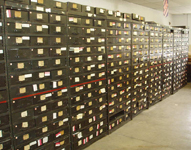
In the distant past, drawings were prepared directly by the Chief Engineer's Office and sometimes the Engineer, Maintenance of Way's Office. In the more modern era, starting in the 1920's and lasting through the Chessie System era, a subordinate office of the Chief Engineer was responsible for preparing the drawings. This official was called the Office Engineer and he and his staff comprised the "Office Engineer's Office". This is the location where the engineers and draftsman worked , from which field forces were dispatched, and to which their notes and data were returned. The office also maintained the file copies of all original drawings and engineering data and had them reproduced and sent on demand to the locations where they were needed. The drawings were housed in a series of large metal drawers along one wall of the Office Engineer's Office which was called "The Great Wall". In connection with the Office Engineer's drawing filing system, a card index file was maintained onto which an entry was made for each new drawing that was created. The cards list drawings for the main series and for the sub-sets with letter prefixes. The cards were filed alphabetically by station name. Entries were made as the drawings were prepared and are thus in chronological order. A second set of cards listed the drawings in numerical order and a third set of cards were organized by selected subject, such as: engine terminals, coaling stations, freight stations, etc.
Within the overall group of Chief Engineer's Drawings, there are sub-sets of drawings designated with a letter prefix. These letter prefixes are indicated on the drawings themselves and on the index cards. The following list shows the various letter prefixes used and a brief description of each type of drawing and its use:
- BL − This collection contains drawings prepared by the "Engineer of Branch Lines" which was apparently an office created in the early 20th century during the time that so many branch lines were being constructed to tap into the many coal lands. The series runs from about 1902 to about 1920 and consists mostly of ink on linen drawings of various sizes. Some drawings also show some mainline facilities.
- CE − This collection contains drawings that are very similar in subject matter to the "X" Series. We have a few hundred of these drawings which are all 8 1/2"x11". The reason for the "C.E." prefix is unknown; but, may have stood simply for Chief Engineer.
- MW − This collection contains drawings that were prepared by the "Engineer, Maintenance of Way", which was another sub-office of the Chief Engineer's Office. These drawings supplemented and eventually replace the "S" series Standard Drawings. Most of these drawings are track and roadway standards, such as: turnouts, ballast profiles, track construction details, etc. Many are 5"x14" or slightly shorter or longer so as to fit in Standards Books which were supplied to Division officials and engineering personnel all across the system. The collection also includes drawings that show roadway improvements, surveys, diagrams of accidents, and a variety of other subjects which could just have easily appeared in the Office Engineer's main set of drawings. The C&OHS has a very incomplete set of these drawings with the majority being blueprints for use in the Standards Books. Only a few are the original ink on linen plans.
- R − This collection contains Joint-Standards drawings for all Van Sweringen affiliated railroads (C&O, Erie, NKP, PM). They are Maintenance of Way Standards and all are blueprint copies which were made for the Standards Books.
- S − This collection contains various Standard Drawings that range from standard station buildings and other structures, hardware, furniture, tools and implements, etc. They are of various sizes but generally are not larger than 24"x36" and are almost all ink on linen drawings. The practice of using this set of standards seems to have been discontinued in the 1920's and most standards thereafter were drawn by the Maintenance of Way Department and were contained in their number series as noted above.
- SD − This collection contains standard drawings for the Signal Department which had its own draftsmen. They are standards for signal facilities of all types and are generally small so they can be used in Signal Standards Books which were supplied to maintainers and supervisors, etc. The C&OHS has only a few of theses drawings.
- V − This designation, which is only shown on the index cards, referred to a "Vault Number" which told the Office Engineer's personnel that a particular drawing was not located in The Great Wall. This prefix referred to a specific storage area where odd sized or over-sized drawings were stored. Many very large and long survey drawings are part of this collection. Also contained in this collection are drawings from other railroads, early independent lines that were merged into the C&O, commercial drawings, drawings from contractors who built C&O facilities, large maps, etc. Other items in this collection included commercial atlases and other similar publications.
- WS − This collection contains drawings prepared by the Water Service Department which had its own draftsmen. These drawings are of standard water facilities, piping, details, etc. and other drawings for particular locations necessary to facilitate construction, installation, maintenance, and use of the water facilities, including pipes, pumps, tanks, etc. The C&OHS has only a few of these drawings.
- X − This collection contains drawings that were generally small and could be filed flat in an ordinary letter-sized file folder. Almost all of these are 8 1/2"x11" or 8"x10" size. They are mostly ink on linen; but, perhaps 10% of them are estimating forms used to prepare costs for the installation of side tracks or industrial spurs. These pages have a small plat drawing at the top and the bulk of the form consisting of cost and material estimates. These are on onion skin paper so as to be reproduced by the diazo process and are very delicate.
Hard Maps
These drawings were prepared using data and notes gathered from the engineering and surveying personnel working out in the field. Regular engineering drawings, primarily the Valuation Maps, were made using the hard map as a starting point and tracing over them. Hard Maps are drawn with both ink and pencil on thick linen which is backed with a stiff paper which creates a very thick substance, thus the name. These are not translucent and cannot be reproduced using the old blueprint or diazo method.
These drawings are only partially organized. They are searchable using the card index; but, are not included in the computer Drawing Database.
Background:
The general history of the C&O's Engineering Department is that it was first headquartered in the railway's main offices in the First National Bank Building in Richmond, VA until about 1960. About that time, the engineering office was transferred to Huntington, WV and installed in the Operating Headquarters Building (O.H. Building) which was an obsolete General Electric factory building that the railway had purchased. During the move, the drawing files were purged and many obsolete drawings were destroyed. After the move, periodically, obsolete drawings were destroyed as well. Other drawings that pertained to structures were transferred in the 1960's to the newly created Architect's Office. When the C&OHS visited the O.H. Building, this office was also visited; but, only a portion of the structure drawings were allowed to be removed.
The C&OHS began acquiring drawings from the Office Engineer in 1982. At that time, representatives from the C&OHS would spend one or two days at the O.H. Building in Huntington, WV where a representative of the Office Engineer would help us go through the drawings drawer by drawer and he would identify which drawings he considered surplus. These drawings would be given to the C&OHS and the ones he wanted to retain were put back in the drawers. This process went on for about four years whenever a C&OHS representative could make the trip. The C&OHS representatives were often Thomas W. Dixon, Jr. and J. Randolph Kean, supplemented on occasion by various other C&OHS members.
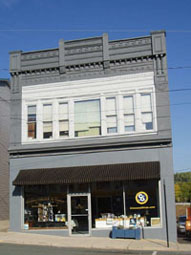
By this time, 1986-87, CSX had made the decision to consolidate all of the engineering operations in Jacksonville, FL and close the O.H. Building in Huntington, WV. Then president of CSX, Ron Drucker, agreed that the engineering department personnel would leave in the O.H. Building anything they didn't want to move to Jacksonville. At a pre-arranged time, a team of C&OHS volunteers arrived and removed from the building all the materials that had been left. This material was place into two boxcars, which were also donated to the C&OHS, and moved to the C&OHS Headquarters in Clifton Forge, VA. The material from one of these cars formed the basis for the initial collections in the C&OHS Archives Building at 312 E. Ridgeway St. in Clifton Forge, VA in 1987.
Mechanical Engineering Drawings
This is a vast collection of mechanical drawings that detail nearly every aspect of the C&O's diesel locomotives, passenger cars, and freight cars. This collection includes: car diagrams, general arrangement drawings, and painting and lettering diagrams, for nearly every piece of rolling stock that the railroad owned. All of the drawings are organized using a numbering system developed by the C&O's Mechanical Department. These drawings are partially indexed in the online Drawing Database and there is a card file index for the freight car portion of the collection. Some of the painting and lettering diagrams are cataloged in Hollinger Boxes.
Bridge Engineering Drawings
This is a special collection of engineering drawings detailing various bridges all along the C&O system. These drawings are partially organized and indexed on paper; but are not yet in the computer Drawing Database. There is also a partial card file index for these drawings.
Valuation Maps
This is a special series of Engineering Drawings originally created between the years 1913 and 1916 as required by the Interstate Commerce Commission and regularly updated as needed thereafter. These drawings, officially labeled "Right of Way and Track Map", but commonly referred to as "Valuation Maps", show all of the property owned by the railroad including the entire right-of-way, track layout, curvature, building and structure locations, etc., for the entire railroad system, mile by mile. The drawing size is standardized to be 24"x50". We have the original, ink drawn on linen, drawings which were completed in June 1916. We also have blueprint or blueline copies of a very few maps that have been updated with revisions. These maps are organized by sheet number in their specially built wooden cabinets; but are as yet un-cataloged and are not in the online Drawing Database.
Hinton Division "As Built" Engineering Drawings
This is a small, special collection of drawings related only to the Hinton Division of the C&O and comprises only "As-Built" plans. "As-Built" means just that, these plans show what was actually built, which makes them an exceptionally valuable resource. These plans are blueprint copies of regular Chief Engineer's Drawings. Most, if not all, of these plans are included somewhere in that collection; however, this special series of blueprint copies have been organized and kept separate because there is a great deal of interest in this particular Division of the C&O. These drawings are completely indexed and cataloged on paper, but are not in the online Drawing Database.
Chicago Division Engineering Drawings
This is a special collection of engineering drawings related only to the Chicago Division of the C&O. These include plans labeled: C&O; C&O of Indiana; Chicago, Cincinnati & Louisville; Cincinnati, Richmond & Muncie; Chicago & Cincinnati; and Cincinnati & Indiana Western; all of which were predecessors of the C&O and were merged into the C&O in 1910 to become the C&O's Chicago Division. This collection also includes plans that were developed by the C&O's Division Engineer's Office in Peru, IN. These plans are drawn on a variety of media including: linen, vellum, sepia, blueprint, onion skin paper, and regular paper. Most of these plans are not included in the larger collection of C&O Chief Engineer's Drawings. These drawings are designated in the C&OHS Drawing Database by the "Collection" notation: "COI" (for C&O of Indiana.) These drawings are partially indexed in the computer Drawing Database and are partially cataloged.
Steam Locomotive and Tender Erection Drawings
This is a collection of Mechanical Drawings that detail the design of the various parts of several of the C&O's classes of steam locomotives and tenders and contains construction, or erection, drawings showing how all of the parts are assembled. All of the plans are drawn in ink on linen or are blueprint copies. These drawings are designated in the C&OHS Drawing Database by the "Collection" notation: "LED" (for Locomotive Erection Drawing.) These drawings are fully indexed in the online Drawing Database and are completely cataloged.
Hocking Valley Railway Engineering Drawings
This is a special collection of engineering drawings that relate only to the Hocking Valley Railway which was merged into the C&O in 1930. These drawings were prepared by the Hocking Valley Railway's engineering department in Columbus, OH. This office was later merged into the C&O's engineering department in Richmond, VA and the engineering drawings were also moved to Richmond intact. When the C&OHS began to remove surplus drawings from the C&O's files in the early 1980's, the HV files were in drawers marked "HV". It was apparent that the C&O made no attempt to integrate these drawings into the main set of drawing files and they did not assign new numbers to these drawings. The C&OHS has maintained the collection in this same manner. The drawings have one or two letter prefixes followed by numbers. It is thought that the letter prefix was to indicate a specific drawer or drawer size in which the drawing was stored when it was created in the 1900-1930 era. It should be noted that the main C&O drawing files contain little in the way of plans from areas of Ohio. It appears that if the C&O Office Engineers needed to draw plans for anything in Ohio, they simply used the Hocking Valley drawings as a source to create their new drawings. The Hocking Valley plans are drawn on a variety of media including: linen, vellum, sepia, blueprint, onion skin paper, and regular paper. Most of these plans are not included in the larger collection of C&O Chief Engineer's Drawings. These drawings are designated in the C&OHS Drawing Database by the "Collection" notation: "HV" (for Hocking Valley.) There is no card index file for these drawings, but the drawings have been fully indexed in the online Drawing Database and are completely cataloged.
Pere Marquette Files
This is a collection of office material and paper files that came from the Potter Street Station in Saginaw, MI which was the headquarters of the Pere Marquette's Saginaw Division. The material has been sorted, but has not been cataloged or indexed.
Hinton Division Files
This is a collection of office material and paper files that came from the Hinton Division Offices that were located in the Hinton, WV passenger station. The material contains numerous transportation and engineering department files. They are completely un-cataloged and in dead storage.
Employee Magazine Collection
The C&OHS has a complete collection of C&O Employee Magazines. This publication was an outgrowth of the Safety Bulletins that began to be issued by the Safety Department starting in 1913 and it has had many different names over the years. On January 1, 1914 the Bulletin that was issued was 29 pages with illustrations and a two-color cover. With the May 1, 1914 issue the name of the publication was changed to the Chesapeake and Ohio Railway Co. Employes' Magazine. From March 31, 1918 to October 1, 1921 the Magazine was temporarily discontinued due to a paper shortage and other stringent restrictions put in place during the World War. With the December 1, 1922 issue the Magazine was placed under the direction of the Public Relations Department. In December 1923 a section on the Hocking Valley Railway was added and the name was changed to The Chesapeake and Ohio and Hocking Valley Employee's Magazine. In April 1930 the name was changed to the Chesapeake and Ohio Lines Magazine. In August 1932 the Chesapeake and Ohio and the Pere Marquette magazines were consolidated and the new publication was called The RAIL. In May 1937 the name was changed to The Chesapeake and Ohio-Pere Marquette Magazine. With the August 1938 issue a section on the Nickel Plate Road was added to the C&O-PM Magazine and the name was changed again to Chesapeake and Ohio Lines Magazine with all three railroads named on the cover. With the January 1944 issue the name was change to Tracks, again with all three railroads listed on the cover, and the format modified from 8 1/2"x11" magazine size to a 5"x7" booklet size.
Official Railway Guide Collection
The C&OHS maintains a partial collection of this railroad industry publication.
Official Railway Equipment Register Collection
The C&OHS maintains a partial collection of this railroad industry publication.
Library Book Collection
The C&OHS maintains a large collection of railroad and transportation oriented titles from a variety of publishers and authors. The collection also contains at least one of every published work produced by the C&OHS.
General Reference Material Collection
The C&OHS maintains a wide variety of general reference material related to various subjects and locations associated with the C&O Railway. This material is organized by subject matter.
Advertising Department Collection
The C&OHS maintains an extensive collection of advertising slicks, artwork, and publications from the C&O Railway Public Relations Department.
Artifacts Collection
This is a collection of material that has been donated to the C&OHS over the course of its existence. It includes items such as railroad hardware, tools, clothing, and misc. railroad memorabilia, most of which is related to the C&O Railway.
Employee Timetable Collection
The C&OHS maintains a collection of C&O and predecessor railroad timetables published by the Transportation Department and covering the entire railroad from a variety of different eras.